Punisher War Machine helped take me to Infinite, but I might give the card about 25 to 30 percent of the credit. I found a card with a fun mind game and a useful lane-pressure tool. Before Infinite, I found one deck where it felt like a small upgrade, at least for now. I did not find a card that wowed me. I tried several different ideas with Punisher War Machine before settling on that final read.
Calling Punisher War Machine broken misses what made it valuable in my games. I'd say that in more than half of my games with Punisher War Machine, the extra max energy was not the point. The marked location changed what my opponent thought they needed to do, and that gave me room to pursue another plan.
That pressure was the benefit I felt most during those particular games: it forced play into the marked lane even when I never played Punisher War Machine.
The Mark Matters More Than the Energy
When drawn, Punisher War Machine marks one of my empty locations. Its objective asks me to win that marked location for plus one max energy. The objective only works while Punisher War Machine is on the board and winning that location.
Both players can see the mark. The visible mark is the card's first piece of leverage. I called that pressure Nebula Syndrome: a long-term lane battle that resembles the way Nebula can pull attention toward a location, except I do not have to play Punisher War Machine for the mark to influence the game.
That pressure can matter even when I never chase the energy. A marked lane tells my opponent that I may want to fight there. They can commit cards to answer that possibility, while I can take the rest of my turn somewhere else. I was asking my opponent to respond to a lane while I pursued my plan somewhere else, and that was how I ended up playing the card in my games.
Judge whether the marked location creates a decision that helps my actual plan. If it does, the card has already provided value before the objective ever turns on.
A Galactus Mind Game.
The Man-Spider Galactus list was the only one that really stood out as a potential home, probably with variations and tweaks. Punisher War Machine's job there was direct: tell the opponent to go to a specific location. That is the same kind of lane control I look for from Nebula in a Galactus deck, except the mark arrives without requiring me to commit Punisher War Machine to the board.
That distinction gives the deck another way to suggest a fight in one lane while I prepare something elsewhere. The card did not need to be the main engine. It was there to make the opponent respect a location that might not be where my final commitment would land.
It also supported a line I enjoyed a lot: Magik into Absorbing Man. Separately, one Magik can be played around. A Magik and then a second Magik puts two Limbos on the board and sells the idea that I need turn seven. That made the eventual rug pull much more convincing.
In the pre-Infinite climb, it felt like a small upgrade for now. It was only a small upgrade, and it was probably the only home where I felt that way.
Ramp Makes Punisher War Machine a Lateral Choice
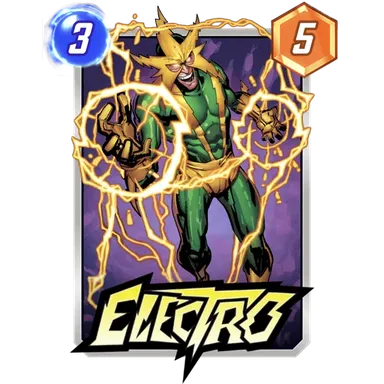
Ramp did well-ish in my testing, with a 60 percent win rate. In that shell, Punisher War Machine was there so I could play Luna Snow or Electro on the marked lane afterward. The aim was to fight for that location and turn it into a ramp route.
I compared the lane battle to Superior Spider-Man, with the added benefit that Punisher War Machine brings its own mind game. It gives the opponent a marked location to consider while I try to set up the energy advantage.
Still, I would call it a lateral move, not an upgrade. Ramp already has other tools, and Punisher War Machine does not automatically replace them. The appeal is that it adds another route besides Wave: Luna Snow, Electro, and Punisher War Machine can work in some combination to win that lane, create extra ramp. The shell could play Infinaut cleanly through several different outlets.
That makes the card worth considering when I want that extra lane contest. It does not make it an automatic ramp inclusion.
Techno Organic Virus Did Not Solve the Home Question
Both Techno Organic Virus decks were mediocre. I tried an Ozymandias and Rocks package, and I probably would have been better off playing Psylocke in that version. I think there may be a Punisher War Machine version somewhere down the line, but it was not that one.
The other experiment paired Professor X with Techno Organic Virus. I liked the idea because Techno Organic Virus can be played into a Professor X lane. The plan was to find Punisher War Machine early and use it as an early ramp option for a four-cost card on turn three or a five-cost card on turn four.
Ramping a five-cost card out on turn four has other routes, and I specifically questioned why I would choose Punisher War Machine over Luna Snow or Electro for that job.
Those tests sharpen the limitation. Punisher War Machine can offer ramp, but the card asks for investment before the payoff arrives. If the deck only wants faster access to bigger cards, it has competition. The card needs a reason to mark and fight a location, not just a vacant slot beside other ramp options.
My Verdict: Fun and Meh
I still do not know the best home for Punisher War Machine. It is a fun card and a cool card, and it can create lane pressure. It also reached Infinite with me.
The cost is the setup. And I was left wondering whether the payoff was worth that commitment. Maybe it needs another point of power. Maybe it needs more time.
I cannot call it garbage. Ramp cards are useful to have in a collection, and I can see the case for it if you do not have Superior Spider-Man. Outside of that, I was not wowed. The card can be a smart bluff, a lane-pressure piece, and a workable option in the right shell. For now, meh is the honest verdict.
Watch the full discussion in the original episode.