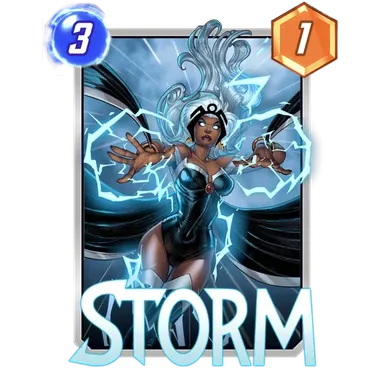
Storm is good. I’m still landing there after three or four hours of testing different shells, because its payoff can put a huge amount of power onto other cards at its lane and into my hand. Yet I have almost no certainty about its best home. That is a strange place to end a Good or GARBAGE review, but it is where I am.
I did see Storm win games. I also kept running into a play pattern that asks me to leave energy unspent, then asks me to stop floating as soon as I have finished. The card has a powerful reward. The deckbuilding around that reward still feels unfinished.
Two Consecutive Floats Are the Deckbuilding Cost
Storm is a three-cost, one-power card. Its objective asks for two consecutive turns with unspent energy, then gives other cards at its location and in my hand +2 power. Consecutive is the important word.
I did not treat the condition as a fixed pair of immediately prior turns. I can complete it at any point, provided I hit that two-turn run. The result is a deck whose curve has to know where those float turns will happen before the game begins.
For me, that meant deciding whether I was floating on turns one and two, or floating on turns three and four with a lower-cost package. That choice was the hard part. Once I had finished the floats, I did not want to keep floating. Storm makes that tension part of every turn sequence.
A plan is more important than trying to squeeze unspent energy into a list after the fact. If I do not know which turns I am giving up, I am caught between building toward Storm’s payoff and playing the cards I already want to spend energy on.
The Counter Can Mislead You During Early Testing
I also ran into what I believe is a visual bug. After skipping turn one, the counter could show one out of two. If I then played a two-cost card on turn two, it could remain at one out of two rather than reset to zero out of two.
Later, after floating energy again, the display could look correct without ever showing that reset. I said the developers were aware of the issue, and it may already be fixed depending on when you read this. Until then, do not treat that counter as a reliable reset signal. Keep track of whether you actually made the consecutive float sequence yourself.
The Low-Curve Shell Felt Better
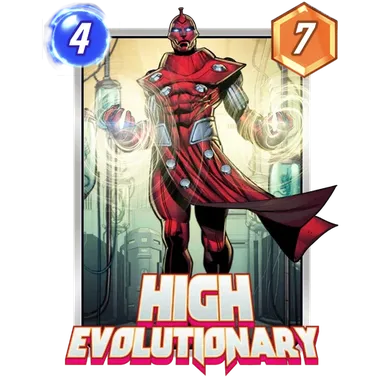
I started with High Evolutionary, hand-buff approaches, and other buff-focused ideas. Across those shells, the same word kept coming back: awkward.
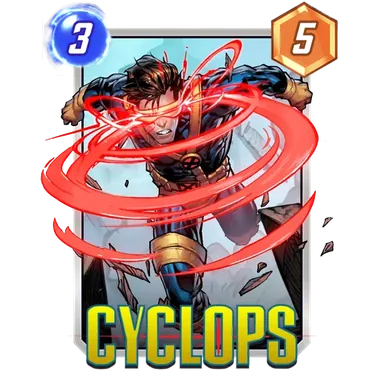
High Evolutionary felt awkward as well. I only felt Storm giving me value on turn four or turn six, and on turn four it worked as an extra support piece if I did not have Cyclops. That did not give me a satisfying answer for where Storm belonged.
A low-curve, board-focused shell felt a little better. I could put smaller pieces across the board first, then use Storm as an extra turn-four or turn-five buff-lane play. That setup can have two or three cards in a lane by the time Storm comes down, which gives the payoff more to work with. Floating in the middle of the game also felt more flexible there.
Even after I found more of that rhythm, I still called it awkward. The low-curve shell did not become a settled home. It just showed why Storm wants early board presence and a curve that leaves room for planned floats.
Why Storm Feels Like a Two-Cost Card
I kept returning to one design read: Storm feels like a two-cost card. I do not think it needs more power. It needs to be cheaper to feel right.
That does not make Storm weak. I am calling it good because so much power can come from this one card. Storm wants more support than it has right now.
I think future buff-deck pieces, boosts, and other reinforcements could make Storm really good. Maybe somebody finds a list that breaks it quickly. Maybe it ends up as a Bounce card. I do not know yet, and I do not want to pretend I can name the top shells after this first round of testing.
A Surfer shell did okay in my testing. With a larger sample and more rhythm, I thought it would probably be better. It was close, not a finished answer.
Good, With a Big Deckbuilding Warning
Storm can win games, and I still think it is a good card. I cannot recommend one best shell yet. Start with the float plan, then ask whether the rest of the curve can support it without fighting the turns you want to play.
Until then, the right verdict is good, with more questions than answers.
Watch the discussion: the original episode.