I see it as a possible sign that Second Dinner is willing to balance Marvel Snap on more than just stats.
Star-Lord loses the priority engine
Star-Lord’s new job is straightforward: it gives energy, and it no longer gains power from the unspent energy that enabled its previous lines. That ends the priority-focused plan of getting Star-Lord down, using Zola, and taking priority at a multiplicative level.
Previously, the energy effect also made Star-Lord larger as the game developed. At seven power now, I do not expect it to keep priority in those same explosive sequences. That is a meaningful removal of the toxic play pattern I wanted gone.
Before the change, Star-Lord could add its gains more than once before the final turn. Removing the growth does not remove the energy, but it does remove the same route to that lead. That distinction is why I see the nerf as meaningful for the old priority plan.
I am not ready to write the card off. It still gives a lot of energy, and I am worried the new version could bring back the Negative deck problem. I also fully expect the Negative Star-Lord deck to stay good.
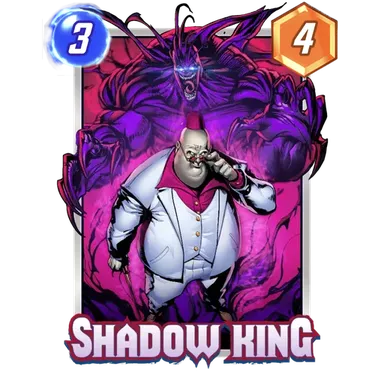
The change also makes Shadow King more interesting in that shell. If I need my opponent to go first before I respond, I no longer have to worry about erasing Star-Lord’s own gained power. Shang Chi remains available. Shadow King also becomes another counter card. The old priority version is gone. The energy engine has not disappeared.
Sholo’s ceiling is lower, and that changes its role
Sholo, the Undying, gets two points of power back while its payoff drops from plus three to plus two for each turn where I play two or more cards. The ideal line moves from adding 15 power to adding 10.
Maverick and Scarlet Spider are where that difference bites. A 15-power Scarlet Spider and a 20-power Scarlet Spider are not interchangeable outcomes. I like that the returned power can at least help Sholo hold its own a little more as a body after the payoff drops. The final turn becomes unfun if it can do too much.
For a tall Maverick, I think Sholo may now be the second-best version. My gut tells me the ongoing Sholo list may end up being the better variation for now. It reflects how much the lost five power matters.
Maria Hill, Martyr, and Archangel get reasons to matter
Captain Marvel is back to six power. I still do not see six power as enough reason to put Captain Marvel in my deck at full cost. I would not mind having it cheated out or played earlier.
I was already playing Martyr in Technoorganic Virus, and the buff improves its case in Zoo and Dormamu. There are enough ways to mitigate its drawback or turn that drawback into something beneficial that I can see it becoming a serious one-cost consideration. I can also see Zoo using Martyr when it is filling up the board. Galactus decks already did really well with Martyr.
I had been building toward a Super Giant deck with a Wiccan backup plan, but the balance of one-costs, two-costs, three-costs, and a large payoff felt inconsistent. Playing Maria Hill on turn one guarantees a random two-cost card in hand, which gives that kind of build another way to continue its curve. That keeps the curve moving while I wait to draw one of the two four-cost cards by turn four. I think Maria Hill has been an underrespected card for a long time. I can see Maria Hill finding a home now, though I do not know how good it will be.
Archangel gets the double buff it needed after missing the mark at release. I had tried many ways to make it work and never felt it had enough force. I am a big fan of the double buff. That moves Archangel from F tier to D tier for me.
I kind of want to treat Archangel in many ways like a less annoying Weapon X: play it down early, do the rest of my work in other lanes, let Archangel’s effect happen. Weapon X got in the way because I did not want to destroy it while it kept scaling. I think Archangel has some decent play lines now.
“Repeat” rewrites the old scaling math
A major system change is the replacement of “happen twice” with “repeat.” This is a massive change in how effects stack.
With Invisible Woman First Steps, the old wording could make the effect happen two times. With two Invisible Woman First Steps, using Joecasta as the example, the effect reached four. With another Invisible Woman First Steps and Chameleon played at the same time, the effect reached six. Under the new wording, those stacked examples go two, three, four.
In the maximum-potential example, the ceiling drops from 32 procs to 17.
Wong, Onslaught, and Mystique all feel this change. The Wong, Onslaught, Mystique combination could scale to an unbelievable amount of procs. Tribunal is dead in my opinion. The ceiling is far lower, and decks that depended on those enormous chains take a major hit.
That leaves Marvel Snap in a stretch of uncertainty. We have this OTA, Mother Escani has just arrived as a powerful new card, a new season is coming, and another OTA follows soon after. The next two weeks could be some of the most fun Marvel Snap has had because the game may keep changing every few days. In the past, I would have told you to play Tribunal when the field was unclear. I cannot give that advice anymore.
For the full OTA discussion, watch the original episode.