
The answer
Your Draft has a direction.
When you take a card, the game records more than its Cost and Power. The Draft files attach tags to cards and Augments. Those tags are part of how later offers are built. That does not mean the game owes you the missing piece for your deck. It means the choices you make are part of the next question it asks.
How a pick follows you through the run
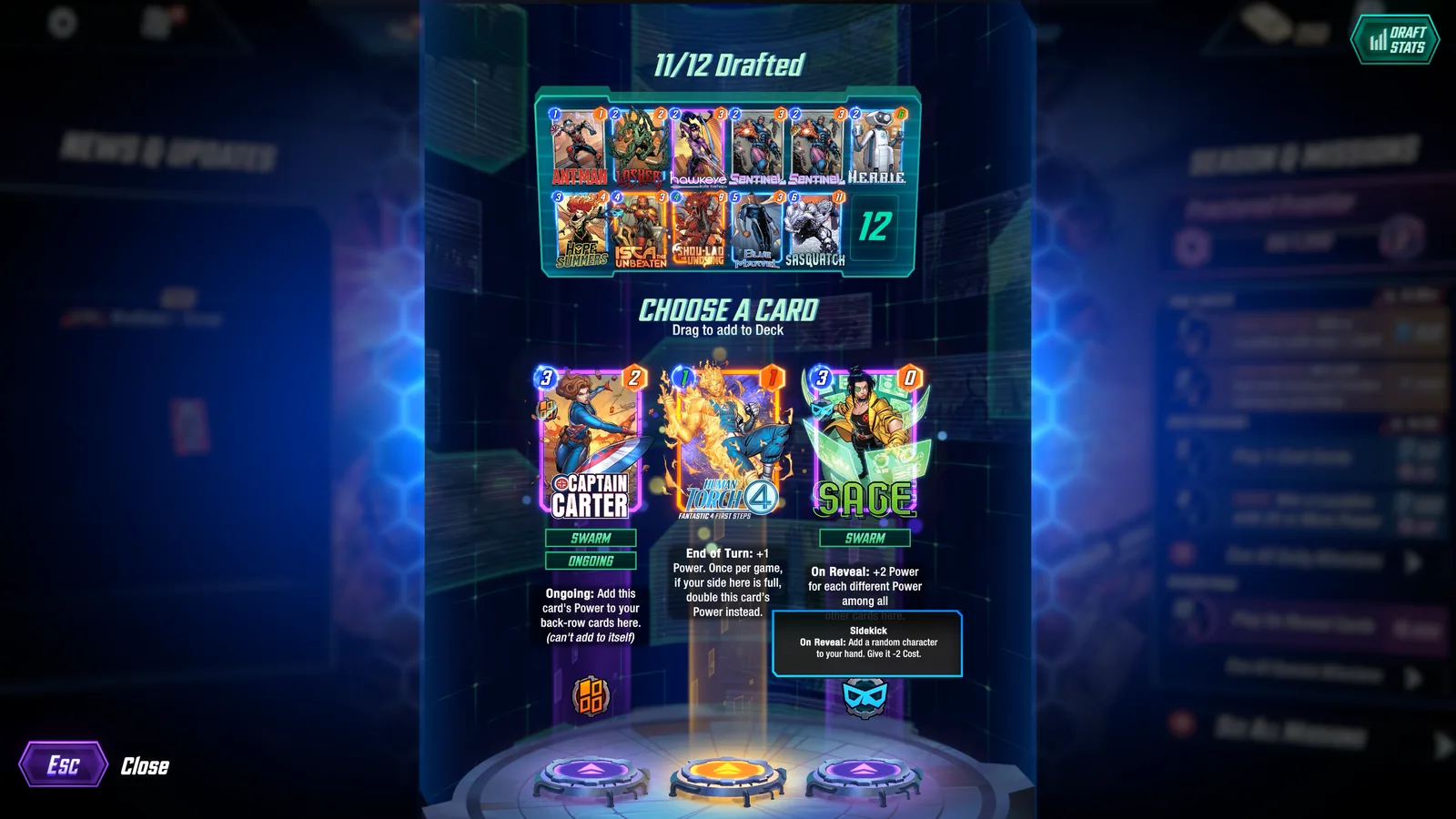
The normal sequence is simple. You choose an opening direction, take cards, add effects, then see another offer. Under the hood, the selected cards and selected mutations both feed Draft tag weights. A deck with a clear identity can keep seeing cards that fit it, even though misses and pivots are still part of the mode.
Starter Pack
Your first direction goes into the run before your individual picks begin.

Cards you keep
Selected cards contribute their own Draft tags.
Augments you add
Selected effects contribute tags too. They are more than a bonus line of text.
Your next offer
The game pulls a legal choice from the current weighted pool.
How to read a good signal
If your first four picks say Move, Draft has a reason to keep showing you Move-friendly cards. It cannot hand you a perfect 12-card deck on command. Take the good glue cards when they appear. A run can go sideways fast when you pass up playable cards while waiting for the one that would complete the screenshot.
How Draft decides what to show you next
The files contain filters and weighted filters. A card must be legal for the current offer, and eligible cards can still be weighted differently by the tags in your run. There is no support here for treating every Draft card as equally likely on every screen.
| What the files show | What it means when you are drafting |
|---|---|
| Filtered pools | An offer can be restricted before the game chooses the cards you see. |
| Draft tag weights | Your picks can push later offers toward an identity instead of leaving every run at the same starting point. |
| Separate mutation pools | The system that puts an effect on a card is its own layer, with its own rules. |
| Several decision templates | A normal three-card pick, a rare decision, and a themed event do not have to use the same screen or the same rules. |
The exact live percentages are not stored in the client files reviewed for this guide. The code shows that the pool is steered. It does not publish the current knob settings. Putting a percentage beside that would be guesswork.
Rare events are their own kind of choice
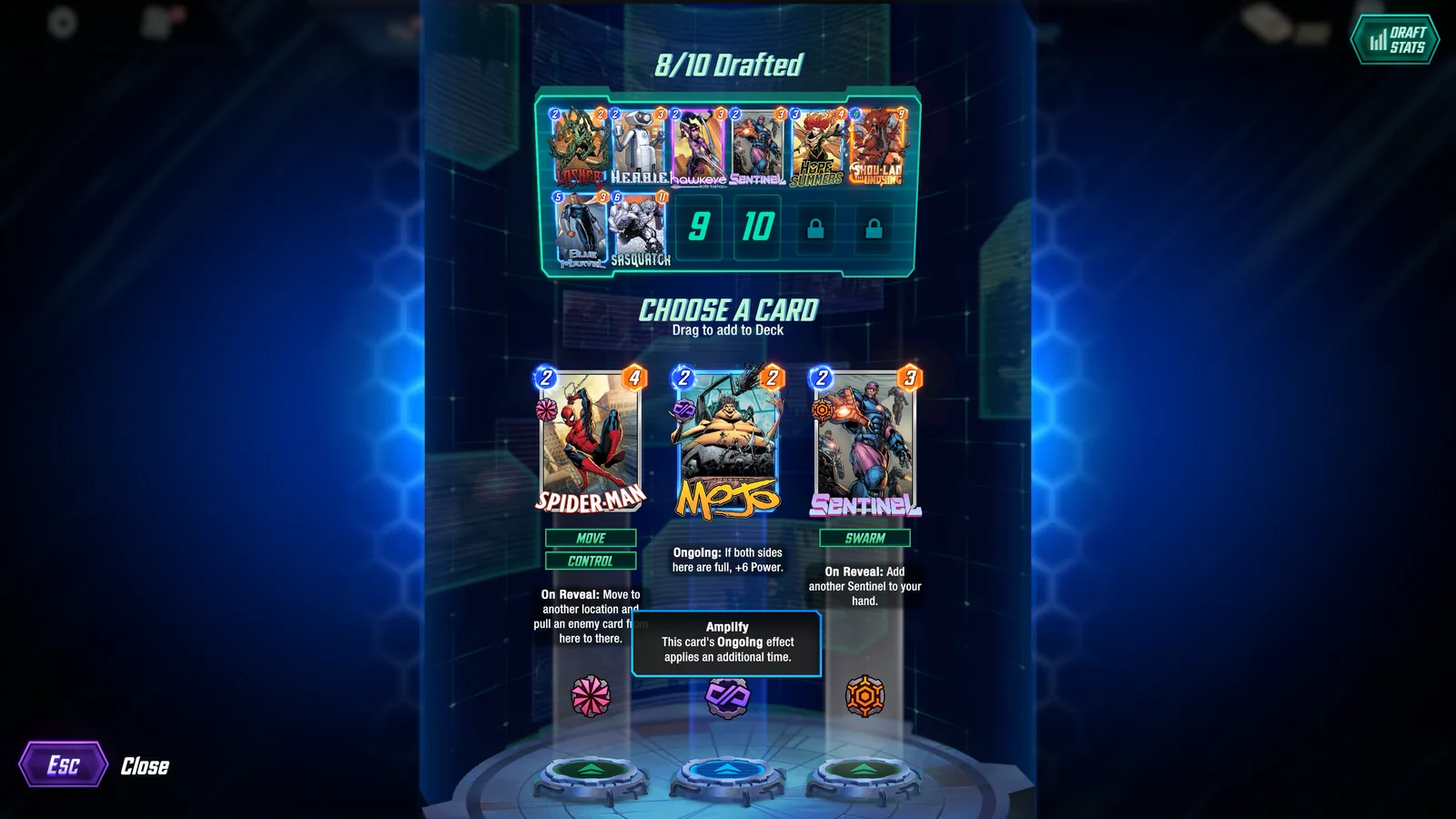
Rare does not just mean a shinier card offer. The Draft files include a rare version of the normal three-card choice, a one-card decision with two possible outcomes, a twelve-card removal screen, and separate screens for Gift of Thanos, Horde, and Hulk Out. Those are different problems for your deck, which is why the right answer changes from run to run.
Three cards, one choice
The familiar Draft format. The rare version can change the stakes without changing the basic decision.

One card, two outcomes
One card can branch into two different effects, so you are choosing the effect as much as the card.

Cut a card from twelve
Deck removal asks a different question: which draw makes every other draw better?

Event-specific screens
Gift of Thanos, Horde, and Hulk Out each have their own authored decision format.
When a rare screen appears, stop hunting for the universally strongest reward. Look at the cards you have, the turns your deck loses, and the one slot you would hate to draw on turn six. That is the context the event is asking you to use.
Why a Draft card can have two effects
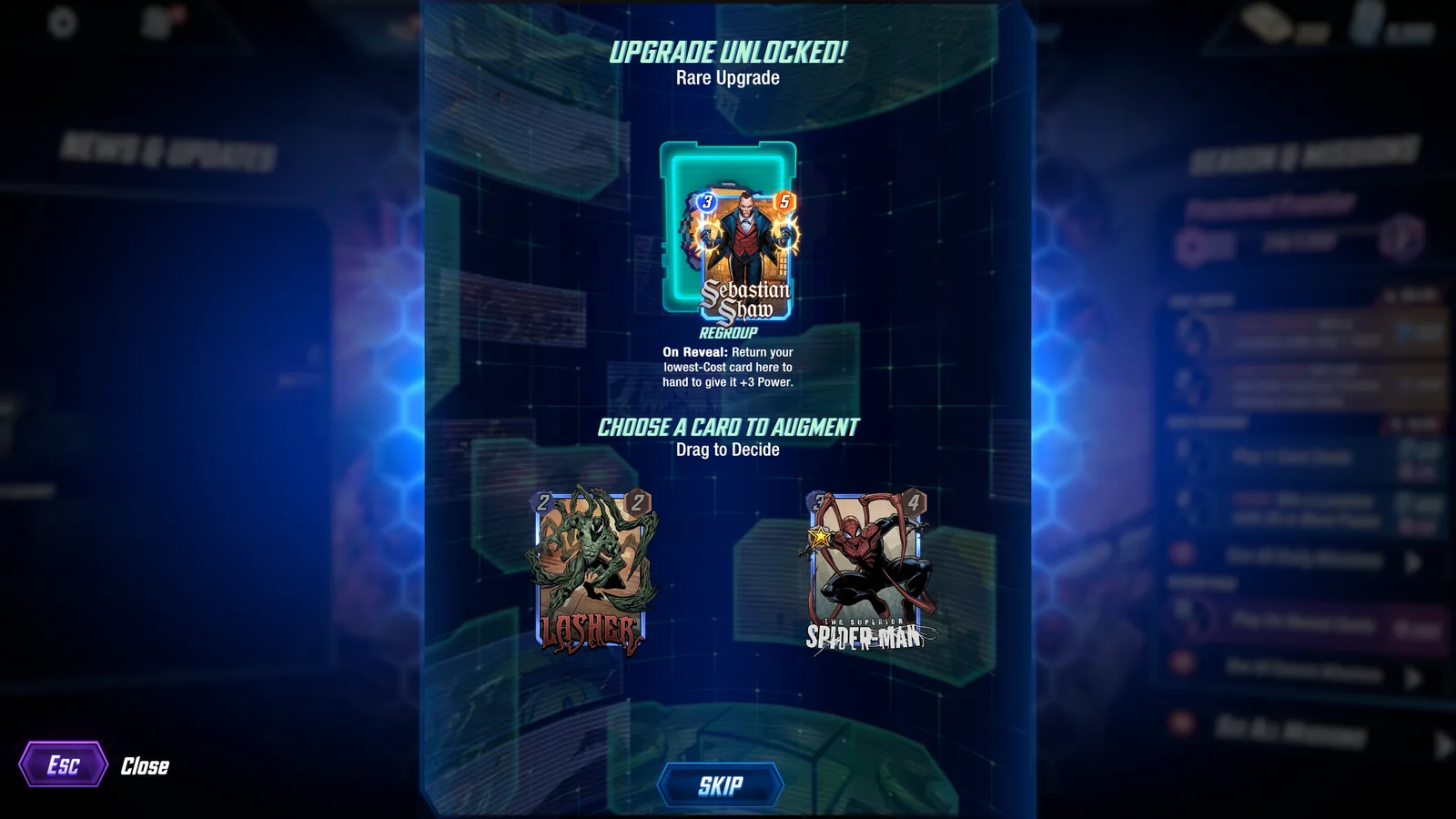
Players have reported cards with more than one Draft effect. The files support that. Card offers and mutations are separate layers, and a selected card stores its mutations as a list. The mutation generator also has a setting for how many mutations can be applied to a card. That is enough to show that a double-effect card is intended behavior, not a broken display.
 The card enters your runThe card is chosen through the normal Draft path.
 The mutation pool is checkedThe game can add an effect from the relevant configured pool.The effects are stored togetherA card can carry more than one mutation in its selected list.
There are still limits. The reviewed files do not show that every card can take every Augment, or that a duplicate effect is always allowed. The eligible pools and live rates decide that. The useful player takeaway is simpler: two-effect cards belong in the mode, so plan around the possibility when an upgrade can create one.
How to use this in an actual Draft
- Give the first few picks more weight. Early cards and Augments set the direction that later offers can recognize. Do not abandon that direction for a random off-plan card with a big Power number.
- Count signals before you commit. One card can be bait. A Starter Pack, a payoff, and a supporting Augment point to a deck worth building.
- Use rare events to repair the deck. Removal is stronger when it cuts a dead draw. A card upgrade is stronger when it fixes a turn your deck keeps losing.
- Leave room to pivot. Draft can point you toward a plan and still miss the payoff. Flexible cards keep a good run from becoming a pile of hopeful picks.
Current Draft catalog
177 released cards excluded from normal Draft offers
*Updated 8/25/26
The current client resolves to 314 active, distinct Draft cards after internal aliases and date-gated future entries are removed. Matched against 491 released cards in the current catalog, the 177 names below are outside the normal offer pool.
Show all 177 released cards outside the normal Draft-offer catalog
A
Abomination, Agatha Harkness, Agent Venom, Air-Walker, Ajax, Apocalypse, Apocalypse, Celestials' Chosen, Askani'son, Astral Projection
B
Baron Mordo, Baron Zemo, Bast, Beta Ray Bill, Black Bolt, Black Cat, Black Knight, Black Swan, Black Widow, Blade, Boomerang, Bullseye
C
Cable, Caiera, Cassandra Nova, Cerebro, Cobra, Colleen Wing, Colonel America, Copycat, Crossbones, Cyclops
D
Daken, Danger, Daredevil, Darkhawk, Death Fractured Frontier, Destroyer, Diamondback, Doctor Octopus Fractured Frontier, Dracula, Dragon of the Moon, Drax
E
Ebony Maw, Echo
F
Falcon, Fantasticar, Fantomex, Fenris Wolf, Firehair, Firelord
G
Ghost, Ghost Rider, Gorgon, Green Goblin
H
Havok, Hazmat, Hela, Helicarrier, Hellcow, Hellcow Fractured Frontier, High Evolutionary, Howard the Duck, Hydra Bob
I
Ikari, Infinity Ultron, Invisible Woman
J
J. Jonah Jameson, Jane Foster Fractured Frontier, Jane Foster Mighty Thor, Jean Grey, Jim Hammond Human Torch, Jubilee, Jubilee Silver Surfer, Juggernaut Horseman of War
K
Kang, Khonshu, Killmonger
L
Lady Sif, Leader, Leech, Legion, Lin Lie Iron Fist, Loki, Luke Cage
M
M'Baku, M.O.D.O.K., Mad Thinker, Magus, Major Victory, Malekith, Man-Spider, Man-Thing, Mantis, Marrow, Master Mold, Maximus, Miek, Misery, Mister Negative, Misty Knight, Mobius M. Mobius, Moon Knight, Morbius, Morph
N
Namor, Nicholas Scratch, Nick Fury, Nightmare, Nova
O
Omega Sentinel
P
Phoenix Force, Pixie, Polaris Horseman of Pestilence, Professor X, Proxima Midnight
Q
Quake, Quicksand, Quicksilver
R
Ravonna Renslayer, Red Shift, Rescue, Rockslide, Rogue, Ronan the Accuser
S
Sauron, Scorn, Scorpion Brand New Day, Selene, Selene Horseman of Famine, Sentry, Sersi, Shocker, Silver Samurai, Silver Surfer First Steps, Sinister Six, Snowguard, Spider-Ham, Spider-Man Noir, Stardust, Stature, Storm, Storm Horseman of Famine, Strong Guy, Sunspot, Super-Adaptoid, Super-Skrull, Supergiant, Surtur, Swarm, Sword Master, Sword of Fu Xi
T
Tarantula, Techno-Organic Virus, The Fallen One, The First Ghost Rider, The Infinaut, The Ten Rings, The Thing, Titania, Tombstone, Triton, Typhoid Mary
U
U.S. Agent, Uatu the Watcher
W
War Machine, Warpath, Wasp, Weapon H, Wild Child, Wolverine Horseman of War
X
Xorn
Y
Yellowjacket, Yondu
Z
Zabu, Zombie Galacti, Zombie Power Man, Zombie Sentry
MARVEL SNAP Draft offer engine FAQ
Is MARVEL SNAP Draft completely random?
Draft uses filtered and weighted offer pools, plus the tags from cards and Augments you have selected. The pool is not equal-odds.
Do Draft Augments affect later card offers?
Selected mutations feed Draft tag weights alongside selected cards. An Augment can therefore change the card in front of you and help shape the kind of offer you see later.
Does a Starter Pack lock me into one archetype?
No. It gives the run an early direction. You can reinforce it, pivot away, or take flexible cards when the rest of the offer does not cooperate.
Can a card have two Draft effects?
Yes. The reviewed files store mutations as a list and include a mutations-per-card setting, which supports more than one effect on a Draft card.
Why does this guide not list exact odds?
The reviewed files show the systems that filter and weight offers. They do not expose the current live values for every pool and event. Exact odds need the live configuration behind those systems.