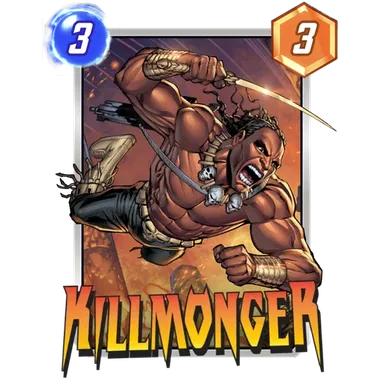
Mr. Atlantic puts Zoo's central tension in focus: how much should a player invest in one-drops when Killmonger can erase their payoff? Zoo already needs enough points to justify playing a lot of one-drops and accepting the threat of Killmonger. Mr. Atlantic has interesting hooks, yet the current version does not deliver a payoff that changes that equation. Venus and Symbiote Spiderman also do not produce the interactions that looked promising. Even if both interactions worked as hoped, the assessment would probably stay 95 percent the same.
Mr. Atlantic asks too much from a one-drop
One-drops are difficult build-arounds because there is only so much room to make them matter without pushing their numbers too far. A card can be a useful support piece by accident, but a true build-around needs players to shape a deck around it. That is a much heavier demand.
The important distinction is between one-drops that succeed as strong stat lines and one-drops that ask players to build a deck around them. Mr. Atlantic is the harder kind of release: a card expected to inspire a package while still needing enough numbers to justify all of that work.
The contextual problems make the structural problem harder to overlook. Venus does not work with Mr. Atlantic as hoped. Its payoffs are also vulnerable to Killmonger, which can erase a one-drop deck's payoff.
An attempted interaction with Symbiote Spiderman captured the frustration. The attempt was meant to produce a larger buff, but it did not work as hoped. It was a missed cool line, not a complete answer. Even if Symbiote Spiderman and Venus worked, the assessment would probably be 95 percent the same.
One proposed improvement was for Mr. Atlantic to give its cumulative buff to the card it made. That remains a possible improvement, not a proven balance fix. Compatibility changes alone would probably leave most of the verdict intact. The issue is not a single broken interaction. The card needs a more convincing reason to exist before Zoo players should buy it as a one-drop build-around card.
Zoo's output-versus-protection problem
Mr. Atlantic opens a broader argument about Zoo. Zoo is a points package rather than a complete deck unto itself. If other point packages produce more power, Zoo has no reason to occupy the competitive space.
One side argues Zoo needs enough output to make opponents reach for Killmonger before it receives better protection. The counterargument is that Killmonger already makes a higher-ceiling Zoo commitment too risky, so cheaper protection could be the enabling change. The output-first view places a lack of numbers in the shell before Killmonger.
Zoo can reach a higher ceiling when it leans harder into its one-drop plan, but that same commitment exposes more of the deck to risk. That is why the protection argument matters: cheaper protection could make a heavier commitment easier, while added power would still address the question of whether the board's output is really worth defending.
Until Zoo receives enough reward for taking on its weaknesses, a new one-drop build-around remains a hard sell.
That divide matters because Zoo changes as a collection grows. Early versions can lean on ongoing cards; later versions can become more focused on small individual pieces. The discussion defines Zoo through one-drop synergy rather than a required individual card. That leaves room for a late-game payoff that does Zoo's job more effectively as a collection changes.
A soft season can still be a good season
The case for calling the season weak is a power-level case: few cards have made a major impact, and the releases feel underwhelming when measured against recent standouts.
The discussion sees several contenders near the top and does not settle on a clear answer. In the pro-season case, Venus is popular rather than especially strong, yet players are using it heavily and enjoying it. That kind of success still matters.
That does not erase the weak-season view; it explains why a season can feel better to play even when some individual releases seem underpowered.
New cards do not all have to remake the metagame for a season to have value. Some releases may be a little underpowered. The counterview allows that the releases may be a little underpowered, but treats that as a mistake only for someone who cares solely about buying something busted.
Using the strongest recent releases as a season's sole measure of quality is a recipe for disaster.
The season pass argument is really about who it serves
A real disagreement remains about season-pass cards. One view prefers a targeted, archetype-specific card when spending actual money. A narrow card can feel like a new deck.
The season pass can also be an appeal product for players across the collection track, not just a targeted card purchase. A card with broad applications can help players at different points on the collection track, even if it is not the best card in every deck. That matters for players who are not evaluating every purchase through a fully developed collection or a highly informed metagame lens.
Spiderpunk is the middle ground. The card is broadly useful while retaining specific applications in a particular archetype.
The disagreement comes down to the player the pass is trying to reach. A highly informed player can aim a purchase at a card for a particular deck. Someone with a less complete collection may value a card that works across more decks, because a narrow card can demand cards they do not own. That does not settle the choice between broad and specific releases. It explains why the two approaches can feel worthwhile to different players.
One view says concentrated Snap Pack pools make it more appealing to reserve a narrow card for the week it is available.
Character Mastery rerolls and Marvel Snap art
Character Mastery rerolls receive an uncomplicated thumbs-up.
Marvel Snap art earns praise for Justin Fields and the game's visual storytelling.
Marvel Snap's art direction is called incredible, and its visual storytelling is praised for making the experience of playing the game mesh with the feeling of playing the game. That appreciation extends to the people who make the art and the marketing teams that get it out there across all of Marvel Snap.
The episode also lands on an unexpectedly practical limit to collecting cosmetics. Three hundred fifty purple web borders were bought, and the work of putting them on cards became a nightmare with roughly 300 still left. The regret is about time.
Zoo needs stronger reasons to accept its risks. Mr. Atlantic does not give it those reasons, so skip the card.
Watch the full conversation: the original episode.