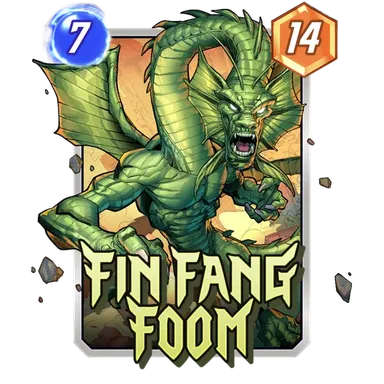
Fin Fang Foom arrives in MARVEL SNAP as exactly the kind of card that makes players want to build nonsense immediately: seven cost, twelve power, and an On Reveal that gains the power of front-row enemy cards at that location. Big number. Big dragon. Big temptation.
The appeal is obvious. The question is whether the condition is easy enough to make Foom a real card or awkward enough to make him a release-week toy.
After testing multiple shells, the answer looks more positive than the cleanest gameplay clips might show. Foom has real upside, especially in decks that can cheat energy, duplicate effects, or use him as another massive payoff. But the card is not plug-and-play. It needs a shell that already wants to do unfair things.
The Short Version
- Fin Fang Foom is a 7/12 On Reveal that gains power from front-row enemy cards at his location.
- The seven-cost restriction means ramp, cost reduction, or cheat effects matter a lot.
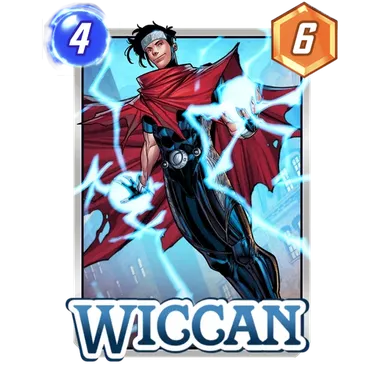
- She-Hulk, Wiccan, Luna Snow, Dragon Lord, and Magik-style lines are natural experiments.
- Hela can use Foom, but early testing did not make that shell feel like the best home.
- Shuri, Taskmaster, Symbiote Spider-Man, and Fallen One style builds create the funniest ceiling.
- Foom looks playable, but the meta’s counters and release-week greed matter heavily.
The Condition Is Easier Than Most Seven-Cost Cards
Seven-cost cards usually come with a giant warning label. If you cannot play the card naturally, the deck has to justify every support slot that makes it possible.
Foom helps himself by having a condition that is not that complicated. You want the opponent to have front-row power in the lane where he lands. That will happen often enough because MARVEL SNAP lanes naturally fill with early and mid-game bodies. The opponent does not have to do something bizarre for Foom to work.
That is a big deal. The restriction is mostly cost, not text.
She-Hulk Lines Make The Most Immediate Sense
The She-Hulk comparison is natural because both cards care about using energy strangely. Moon Girl, Sunspot, She-Hulk, and Infinaut-style decks already understand the idea of skipping or floating to create bigger final turns.
Foom can slot into that mindset with fewer restrictions than Infinaut. He still needs help getting played, but he does not ask you to skip an entire previous turn in the same direct way. Wiccan, Warlock, Luna Snow, and similar energy tools can all help create the window.
The danger is building a deck that has a lot of energy and not enough clean wins. Ramp is only good when the thing you ramp into actually ends the game.
Dragon Lord Is The Obvious Cheat Button
Dragon Lord gives Foom one of the cleanest ways to ignore the seven-cost problem. If you can pull the dragon down instead of paying full price, the entire card gets much less clunky.
That does not automatically make the deck great. Cheat effects always create their own consistency questions: did you draw the cheat card, did it hit the right target, and did the target matter in the lane where it landed?
But Foom is exactly the kind of payoff Dragon Lord wants to be associated with. If the deck is already trying to cheat oversized bodies, Foom belongs in the conversation.
Hela Is Fine, But Maybe Not The Best Answer
Hela can play big things, so of course Foom gets tested there. The problem is that “can play big things” is not the same as “maximizes this specific big thing.”
Early testing made the Hela version feel acceptable rather than exciting. It can work, especially in more refined discard shells, but Foom’s location-specific On Reveal is less guaranteed to matter when he is being repositioned through resurrection plans.
There is also the meta problem. If Stardust and other disruptive tools are already rising, Hela-style greed has to be better than merely fine.
The Funniest Ceiling Is Big-Card Nonsense
The most exciting builds lean into the stupidity. Shuri, Taskmaster, Symbiote Spider-Man, Man-Spider, Fallen One, Magik — all the cards that say “what if the big card got bigger and then happened again?”
That is where Foom’s ceiling becomes absurd. If you can duplicate the On Reveal, double the body, copy the result, or extend the game to find the full line, Foom becomes less of a single threat and more of a combo centerpiece.
Those decks may not be the safest ladder choice, but they are the reason the card is worth exploring.
The Meta Will Decide How Greedy You Can Be
Release week is always weird. Everyone wants to try the new big card, which means Morph gets better, Shang-Chi-style answers get more appealing, Cosmo matters, and players start building around oversized lane fights.
That environment cuts both ways. Foom benefits when opponents put big front-row power into lanes. He suffers when everyone packs the obvious counters.
The card’s long-term value depends on whether he still works after the novelty week ends and opponents stop feeding the dragon for free.
Final Verdict
Fin Fang Foom is better than a meme, but he is not a brainless staple. The seven-cost problem is real, and the best decks need to cheat, ramp, copy, or extend the game to make him worth the slot.
If you like big-card shells, Foom is absolutely worth testing. If you only want efficient, low-maintenance ladder cards, wait for the meta to prove he survives beyond the launch-week dragon festival.