Premium Mystery Variants may be meant to avoid pixels, but should they guarantee a Super Rare Variant?
A New Rung for Premium Mystery Variants
The name and result do not line up in the nine-pull table discussed. It lists six non-pixel Rare variants and three Super Rare variants. The episode leaves that expectation contested: one case is that “Premium” should signal a Super Rare Variant, while the other treats the current reward as protection from pixel pulls. Treat the reward as a mixed pull when you weigh its value.
For a player who still needs Rare variants, that result can retain value. The pressure changes after a collection becomes Rare-complete. That problem becomes more pressing at that point, because the Rare side of the pool no longer delivers the same reward value. That is a long-term collection problem, yet it also exposes a wider design issue: the reward becomes less attractive over time.
There is a meaningful counterpoint. One view is that Premium Mystery Variants may have been introduced mainly to avoid pixel pulls, not to guarantee a Super Rare Variant. Under that definition, the reward is doing its original job.
By the rough, fluctuating estimate used here, there are over 2,000 obtainable Rare and Super Rare variants. The system was created with a much smaller pool in a different Marvel Snap world, and it can feel stale in the present one.
The stronger proposal is a new tier rather than a forced rewrite of the existing one. An “Elite Mystery Variant” was floated as a way to reach beyond the Rare and Super Rare pool, with a possible split between Super Rare and Spotlight rewards. The exact rates and price were not settled. One position is still comfortable leaving the existing Premium Mystery Variant alone while calling for a separate reward tier. A separate reward tier could make premium rewards feel more distinct.
A Separate Home for Past Season Pass Cards
A community proposal asks for past Season Pass cards to leave Collector’s Packs and move into a dedicated pack. Players who chase a card from a previous pass can face a wide pool instead of a targeted route, and a dedicated pool could address both dilution and the desire to pursue Season Pass cards on purpose.
The proposal also touches the way Season Pass cards are experienced. New cards receive attention through decks, videos, streams, and weekend missions. Even when a card is not especially strong, it remains visible.
Not every Season Pass card is broken. Some Season Pass cards have been adjusted quickly, while other examples show that a pass card can take longer to become playable. The case for a separate pack rests less on the belief that every pass card is overpowered and more on the unusual position of a card that is tied to a paid pass for a month.
The episode leaves the proposal disputed: it could improve targeting and pool dilution, but the opposing view does not see another seasonal pack as necessary.
Price Anchors Need More Than Conversion Math
The episode cites 10,000 Collector’s Tokens at US$180 and 3,000 gold at approximately US$42. Those numbers are the proposed ban: price anchors that make a bundle look more valuable than it feels.
The displayed values create a baseline that can feel detached from the practical worth of the rewards. A green neon border, a Premium Mystery Variant, gold, and Collector’s Tokens may each have a published value, yet a player can still look at the purchase and reject the implied deal.
The defense is more complicated than a gold-to-token conversion. Credits, gold, and Collector’s Tokens have different places where they can be spent. Players cannot freely move upward from credits to gold or from gold to tokens, so each currency has a different level of flexibility. A direct exchange calculation misses that part of the economy.
That leaves an uncomfortable limit. The internal weighting behind each currency’s use cases is not public, so the displayed values cannot be fully proven wrong from the outside. They can feel inflated. They can make a poor offer look better. Yet the episode remains divided: one position wants to ban the price anchoring, calling the stated values inflated and wrong even if they are tied to direct gold prices. The counterargument says credits, gold, and Collector’s Tokens have different use cases, and that the proprietary valuation behind that difference is unavailable. Without it, that side cannot confidently ban the anchors.
Album Variants Are Crowding the Daily Shop
Marvel Snap offers eight daily variant slots. Album-tagged variants are consuming too much of the limited daily rotation.
Repeat album variants remain part of the complaint, including for players who have completed albums. A player can have access to many striking variants outside albums and still keep seeing the same album-linked options return.
The requested fix is modest: reduce the album weighting, cap how many album variants can appear in a day, or create a longer gap before a repeated album variant returns. Any of those options would leave albums in the shop while restoring room for variants that have no album connection.
Both sides agree that the shop needs less album weighting. The issue is the overpush of album variants inside a shop with only eight chances per day to show something different.
Transformation Rules Should Say What Actually Happens
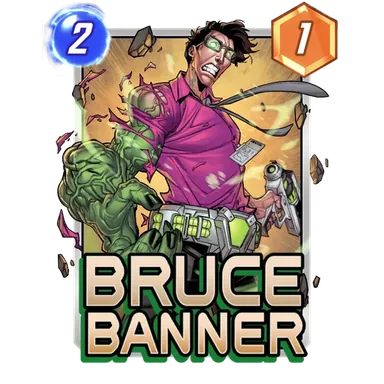
The final ban is inconsistent transformations. It begins with power changes. Bruce Banner is cited among the cards whose transformed forms can retain a power increase or reduction. One case is that transformations should not reset power increases or reductions. The countercase is that the mechanical behavior is not the issue, and the terminology is. Players should not have to infer which version of transformation applies from a character’s flavor text.
The deeper objection is terminology. “Set,” “transform,” “return,” and “Hulk out” are used around effects that do not communicate the same thing. Valkyrie is an example of an explicit set-power effect. The episode uses Mysterio’s swap as a set-power example. Those examples make the wording problem clearer: similar-looking outcomes can be governed by different rules, while similar words can point players toward different expectations.
The frustration is clarity. A card’s text should tell players whether modifications carry forward, whether a new card is made, and whether the effect is a set effect or a transformation. The ruling is to ban inconsistent transformations, because Marvel Snap’s rules text should support planning instead of forcing players to decode it. Watch the full episode: the original episode.