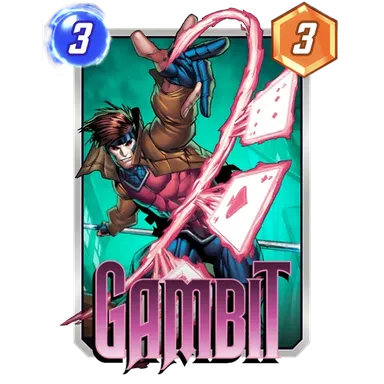
Gambit's OTAA raises a harder question than whether the card gained enough power. Does moving some of Gambit's value out of board destruction and into stats make Marvel Snap more playable when Gambit shows up?
One view accepts the new direction but thinks the added power went too far. Another still preferred leaving Gambit unchanged. That distinction matters because an unpleasant card does not need to be statistically dominant to make a match feel decided before points matter.
The Second Dinner connection needs clear boundaries
A contractor role with Second Dinner is now part of the context around the show. The role is through a personal business rather than direct employment. It does create a boundary around what can be discussed, especially when the subject is an unreleased data mine.
The discussion identifies a stated limit around unreleased data mines: detail is limited to subjects already discussed as a content creator. Data mines remain provisional snapshots that can change, even when a label makes a connection look obvious.
The concern around bundles labeled for an OTAA is still fair. If a player sees that label before a patch, the player has little reason to leave room for doubt about the connection. A mismatch in update cadence offers one possible explanation for why that information surfaced together. It does not establish the order of decisions between balance and product work. The practical suggestion is simpler: avoid labels that turn a provisional data mine into an apparent announcement.
Repetition is part of teaching Captain Carter correctly
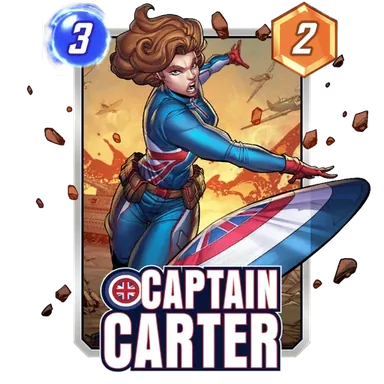
The argument about Captain Carter and Silver Surfer is not that players are foolish for seeing a Surfer card and assuming a Surfer game plan. The point is that contextual knowledge changes how a deck should be piloted. A player who treats the Captain Carter list as a standard Surfer deck can leave with the wrong plan.
That warning can feel repetitive to viewers who catch every upload. The defense is that the audience is not one group with the same viewing habits. Someone who watches a single best-decks upload still deserves to hear about a likely mistake.
Teaching basic context is also different from talking down to the community. The stated job is to give players who do not play as much shortcuts into the metagame. The same logic applies when a Phantom X list is better understood as a tech deck than as a deck built around Phantom X. Repetition has a point of diminishing returns, but cutting the explanation entirely would leave new viewers behind.
Gambit trades destruction for a game that still has points
Gambit's old pattern created a gap between how powerful the card felt and what the available numbers showed. Stats sites are not perfect, yet they do not offer an objective metric proving Gambit was as dominant as the frustration suggested. Blowing up a board can feel miserable, especially when the opponent has little agency left, even if the card's results do not establish it as the format's strongest option.
The OTAA addresses that feeling by reducing Gambit's total destruction output and making four-cost cards safe. One reading of the change focuses on a recent Doom 2099 pain point. A competing reading is that the notes are separating two goals. Lowering total destruction matters on its own, while protecting four-cost cards gives nearly every deck a class of cards it can count on against copied Gambits.
That counterplay changes decisions. A player can plan around cards that will survive. The case for the change is that Gambit's own points should matter in more games. Those are games that do not end because the entire opposing board vanished.
There is still a reasonable concern that the added power went one point too far. A slightly smaller increase may have been enough. One case supports the direction, while another still preferred leaving Gambit unchanged. Gambit has less room to turn a copy line into total board destruction, while a single Gambit can carry more ordinary game play. One view was that many high-Infinite players had already internalized that copying Gambit was poor value.
Small buffs have to survive the next metagame
The wider patch raises a balance problem that is easy to miss. One objection is that removing top decks cannot automatically lift every weaker archetype into relevance, because replacement decks cannot be ignored. A more charitable reading is that Discard and Destroy were expected to benefit more broadly after earlier changes, yet the gains did not spread as widely as projected.
The episode agreed that the earlier changes lowered the format’s point ceiling, but argued that lowering it alone was not enough to make Destroy playable.
Lady Cif and Deathlock are one favored example of a cautious answer. Another view treats Awesome Andy as probably the most meaningful non-Gambit change. More power on Lady Cif and Deathlock helps Discard and Destroy keep pace through the middle turns. The gain comes from points already on the board, which can change priority and make a player more willing to stay in a game. It does not require a larger combo payoff from Deadpool.
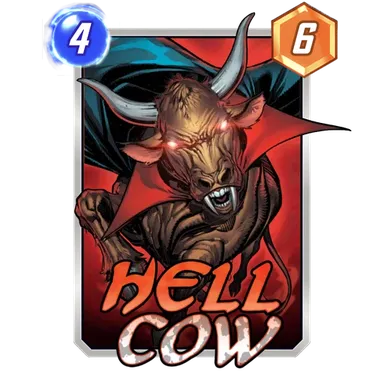
Hellcow looks far less meaningful. Extra base power does not solve the core issue for a four-cost Activate that discards broadly when a card such as Lady Cif can target a specific discard. Angel's added power is welcome when Angel is drawn, but the skeptical question remains: which Destroy deck actually wants Angel's mechanic badly enough for the stat increase to matter?
M. Marvel’s adjacent-location ability was buffed, a change that drew interest. The conversation doubted the buff would lead to many more M. Marvel decks built around her as a stats stick. A proposal to move more of Awesome Andy’s power into its ability instead of its base stats runs into a different risk: the ability is the part players can copy.
Muse needs a home that can afford the work
Muse is the patch's unresolved card. The card can scale well, yet the discussed destroy lines can require energy both to play a card and to destroy it. That makes Muse a poor fit for a deck that wants to spend turns on a tech card such as Mobius instead of advancing its own destruction plan.
In the meta discussed on the show, heavy Mobius play made that deck-building cost sharper. In the discussed Phantom X attempt, fitting Muse’s support pieces cut into room for Mobius and left the deck worse.
Muse still did not have a settled answer. Ongoing Destroy experiments also showed some promise, and Mystique copy play was described as good. Neither line establishes the final shell. The more useful conclusion is that Muse may need a pattern that gains destroys without demanding as much energy investment, with Luna Snow named as one possible direction to explore.
The card's presentation also needs attention. Muse does not update in hand, and caution-tape effects can fail to communicate destruction that occurred before Muse was drawn. The player-facing problem is clear: the visual state should help a player understand Muse's power instead of making the total harder to read.
The episode debated possible Muse adjustments. One proposal cuts the energy cost so Muse can fit into more turns. Another prefers a stronger body while preserving the current cost. Both proposals recognize the same limitation. Muse needs a deck that values Muse's scaling more than it resents the work required to get there.
Bluff snaps deserve more respect off stream
The final strategic point is about bluff snaps rather than a single card. The episode argues that Marvel Snap players trend conservative with bluff snaps, and watching high-level streams can reinforce that caution. A visible streamer has a special problem: an opponent may even check the stream after a snap.
That incentive can make a bluff snap less attractive on stream than it would be in an ordinary game. A streamer avoiding a risky line is not always modeling the best non-streaming decision. Away from stream, bluff snaps can be much more advantageous than watching high-level streamers suggests.
Watch the full episode: the original episode.