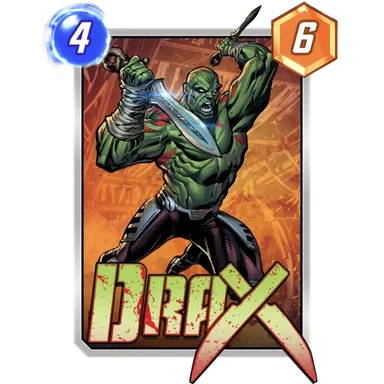
I gave them a shell built around forcing the opponent to play into a lane while preserving my own movement options. It also led me to conclude that Drax and Groot are not worth building backwards.
I started with a straightforward question. Could I build outward from Drax and Groot, use current tools and relevant deck components, and create the conditions where their payoff justified the effort?
To pay off, Drax and Groot need me to guess correctly and hit.
Build the Target Lane First
My first instinct was to multiply the On Reveals. Grandmaster was part of the direction I was considering.
I kept Wasp in the mix because I had found that tactic valuable in a similar shell.
I wanted to give them the best possible scenario: an opponent pushed toward a lane and enough movement to preserve my own options.
The Three-Cost Line Was Getting Thick
Deckbuilding pressure showed up quickly. I worried that the three-cost slot was becoming too crowded.
The list had power and scalable power in mind, but I did not know if it had enough tech.
I still saw enough value to run the experiment, but the construction already carried a warning: Drax and Groot needed a lot of help before the games even began.
The Turn-Three Requirement
The list carried a demanding turn-three requirement. To get the deck working, I needed Jean Gray on turn three.
That is a severe condition for a deck built around cards that already need the opponent to cooperate. A couple of times, I wanted to choose between Jean Gray, Groot, or Venus plus Wasp on turn three.
The turn-three requirement was a major limitation.
This requirement mattered for a back-built experiment. I was asking whether the support around Drax and Groot was worth the deckbuilding cost. The test kept pushing me toward no.
Twenty-One Games Showed the Ceiling
The run was not a collection of complete failures. There were games where the deck really did pop off, and seeing a 12-power Drax felt great.
Across 21 games, though, I lost 21 cubes. The more important pattern was where the deck failed. Against combo decks, it could not keep up with the amount of power those opponents produced.
Even in the favorable setup, Drax and Groot only kept up. I had put them in the position where the opponent was pushed toward their lane and the deck had support around them. Their reward still did not move beyond the wider scaling available in the game.
The strong games do not overturn the result. Drax and Groot require a proactive guess and hit, and their payoff can equal, or be lower than, other options.
Why Proactive Mitigation Is the Problem
The central issue is the kind of downside Drax and Groot carry. The comparison was limited to cards with a negative or downside, including Sentry, Atuma, and Crossbones. Their downsides can be mitigated retroactively.
The two-fold problem remains. They need a guess and a hit, then the reward can still equal, or fall below, what another scaling option can provide. The risk is not worth the reward.
Drax and Groot need a little more power, though I cannot tell whether it belongs on their base numbers or their effect. The source of the problem is clearer than the fix: their current payoff does not cover the work required to unlock it.
The Backward Build Reached Its Verdict
I still want Drax and Groot to become relevant. My conclusion from this build is narrower and firmer: Drax and Groot are not worth building backwards.
Drax and Groot are not enough reason to commit the shell around them, even after giving them lane pressure, movement, and their preferred conditions. For now, they stay at the bottom of the tier list.