Extra energy helps when it lets you make a useful play you couldn't afford. If your MARVEL SNAP hand already fits into the energy available, adding another discount or ramp effect doesn't give you another payoff. You still need something worth playing.
That's the question to ask when the setup succeeds and the final turns still feel weak. Look at what is left in your hand. Are good plays too expensive, or have you run out of good plays?
The proposed combo exposed the problem
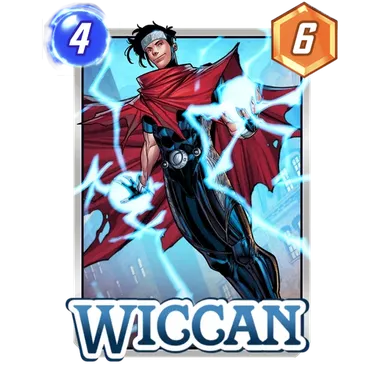
In Marvel Snapcast Episode 152, the August 14 discussion explored putting Wiccan, Doctor Octopus Fractured Frontier and Hydro-Man together. The attraction was arranging a big card for a later discounted play. The pushback was practical: what would the deck actually do with all those resources?
The conversation never settled on a tested list. One host liked the positioning idea. Another worried that Wiccan decks could already have more resources than useful things to spend them on. They also considered whether the card generated by Doctor Octopus Fractured Frontier might provide another play, then kept questioning the package.
That uncertainty is part of the example. It was a deckbuilding conversation, with an appealing interaction and an unresolved payoff problem. The existence of a clever setup didn't establish that the resulting hand was better.
You can apply the same question to your own list without copying the proposed cards. Once your energy plan works, what does it let you put on the board?
Count useful plays at the payoff turn
Start with the turn the extra energy is supposed to improve. Write down the cards you expect to have available after making the setup plays. Include their costs and the jobs you need them to perform on that board.
Keep cards already in hand separate from cards you're hoping to draw. Both can belong in a plan, but they aren't equally dependable. A line that works with the hand in front of you has a different requirement from one that still needs the right topdeck.
Then compare the playable combinations. Does the additional energy let you deploy another threat, combine an answer with your own Power, or play something earlier than otherwise possible? Name the actual gain. “More energy” is only the first half of that explanation.
If every useful combination was already affordable, check another part of the deck before adding more setup. The shortage may be a payoff, access to another card, or a card that can do the job the current hand cannot.
Once you've identified those useful plays, the sequencing guide helps examine when to make them.
A simple hand check
Consider this hypothetical planning exercise. You have a useful threat that costs four energy and a supporting play that costs two. For this example, those are the only useful cards left in hand and there is room to play them.
| Energy available | What changes for this hand? |
|---|---|
| Five | You cannot play both cards together. More energy could unlock a meaningful combination. |
| Six | Both cards are affordable. You can execute the planned turn. |
| Eight | The same two cards still cost six. The extra energy needs another useful card or effect to produce an additional benefit. |
These are invented costs for illustrating the decision, not a current card recommendation or a reported match. The point is to compare the energy with what the hand can use.
The eight-energy position might become valuable after another draw. It might also let a different hand do something stronger. Neither possibility means this particular hand has gained another play already.
Account for what the setup used
Ramp and discount packages occupy slots in the deck. Playing the setup also changes what's left in hand. If you count the future energy but keep imagining a hand full of cards you've already spent, the payoff turn will look much better on paper than it does in the game.
Follow the whole sequence. After each setup card, note what leaves your hand, what becomes available, and what still has to arrive. If an effect supplies a random card, leave its usefulness uncertain until you know what it is. An extra card isn't automatically the specific answer your plan needs.
The Episode 152 exchange illustrates that last point. The generated card came up as a possible answer to the shortage, not proof that the shortage had been solved. Don't quietly turn a possibility into the strongest card you could receive.
If you're rebuilding the package, the deckbuilding guide can help separate the central plan from its support. For the original exploratory discussion, the Episode 152 article gives the wider context.
Before adding another energy card, complete one sentence with a real follow-up: “This lets me play ___ on the turn I need it.” If you can't fill that space, work on the hand that will spend the energy.