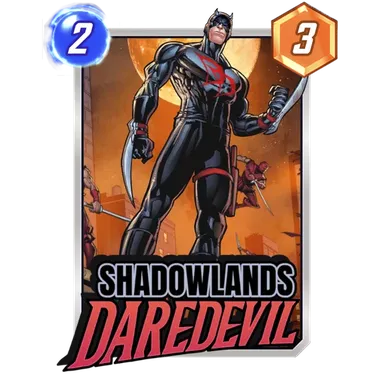
I expected Shadowlands Daredevil to be more awkward to play. Across about 91 games testing the two cards, I finished with the opposite feeling. Shadowlands Daredevil was smooth, opened more lines than I expected, and overperformed my first read. He also impressed me, though he asks for a more specific home. My early verdict is simple: both are good, but Shadowlands Daredevil is the stronger early recommendation.
Shadowlands Daredevil rewards the draw after turn two
Shadowlands Daredevil shuffles three demons on reveal, then gives +2 power to every card I draw with six or more power. That last clause is the engine. The bonus is not limited to the demons. Any qualifying draw gets it, which makes the card attractive when the rest of the deck already wants to draw large cards after Shadowlands Daredevil comes down.
I tried cheeky ideas and straightforward stat-focused lists. The straightforward stat approach was the better home. The demons still matter, but their value goes beyond their own power. They change how I can use my hand while the larger draws keep scaling.
Playing Shadowlands Daredevil on turn two gave me more flexibility than I expected. The added demons did not leave me feeling trapped by deck thickening. Their power helped compensate for those extra cards, and playing them out could make room in hand. The deckbuilding check is still important: some decks want this effect and some do not. I would not force it into a shell that cannot keep feeding it six-or-more-power draws.
Wilson Fisk rewards priority, and ties still count
Wilson Fisk was a different kind of surprise. My concern was that he would be a priority play early and lose relevance once the board got bigger. Testing moved me toward a more generous read. He felt available in hand more than I expected when I held the highest power among cards in play.
The tie rule matters. If Monster Island shows up as the third location and both players have 10-power cards, the tie still qualifies. That makes the condition less restrictive than it first sounds.
Priority decks were the recurring fit. Super Giant decks stood out, and Wilson Fisk's late flexibility created room for jukes rather than locking him into a single early turn. I see a strong priority tool that gets better when the rest of the deck is built to meet his condition.
Sand in Your Eyes delivered while Darkhawk stayed unresolved
I split the testing across two Shadowlands Daredevil-only decks, two decks with both cards, and two Wilson Fisk-only decks. The cards held distinct roles, and they also worked well together.
Sand in Your Eyes was my second-best result of the day: plus 15 cubes, a 70% win rate, and 20 games. I built that line around Black Swan, Mobius, and Technoorganic Virus. I also saw room to adjust the tech package. Cosmo, Luke Cage, and Shadow King were all options I named without abandoning the core shell.
Darkhawk gave me a more complicated result. That test ended at a 55% win rate and negative one cube across 20 games, with three eight-cube losses. Two of those losses were by one point. I still thought Darkhawk performed well on its own. A five-cost Darkhawk by itself might be an option this week, though I did not know what that version looked like yet. In that testing, I also thought Cassandra Nova was better than Darkhawk right now.
Ramp was the best deck of the day
Ramp was my best deck of the day with Shadowlands Daredevil. The card did two jobs there. It replaced Moon Dragon in that style of deck, and it gave me more fodder for Blink. Ramp naturally draws cards that meet Shadowlands Daredevil's power threshold, so the repeated +2 bonus had the targets it wanted.
Professor X was better without Wilson Fisk and Prowler; Mr. Negative needs more testing
The Professor X experiment was useful because it showed where Wilson Fisk did not fit my original plan. I wanted to use him with a small move package, then lock a lane behind Professor X. The result was blunt: I thought the deck would do better without Wilson Fisk and Prowler, using the original version instead. That card was a fun surprise play and flexible on turn six, but that particular strategy did not earn his slot.
Mr. Negative with Blob showed potential, but it needs more testing. The plan was deliberately to avoid playing Shadowlands Daredevil before Mr. Negative, then bring Shadowlands Daredevil down on turn six amid the larger sequence. I recorded several 24-power Blobs and won games, including big-cube games where the combination was not expected.
I ran out of time before I could give that version a larger sample. There may be strength there, yet I had not settled whether Zola, Taskmaster, or another piece should change. That uncertainty matters.
Ronin gave Wilson Fisk a strong Super Giant partnership
The Ronin build was probably a high-pilot deck that felt very close. I liked the number of demons available for Ronin on turn six, along with the power and control the list could produce. I kept going back and forth on one card choice, though, and I had not found the final tweak. The list needs one more change, even if it is not a major one.
The Super Giant and Wilson Fisk combination was fantastic. I liked it with or without Shadowlands Daredevil, and I liked it better with Shadowlands Daredevil. That pairing is a reason I am excited about Wilson Fisk. The full Ronin list still needs revision, but the partnership itself already earned my confidence.
My current ranking of both cards
Shadowlands Daredevil gets an easy thumbs up from me. The season pass has great value, and this card specifically overperformed what I expected. I thought it might be clunkier or more awkward. Instead, it felt smooth because the demons brought flexibility while qualifying draws kept gaining power.
He is also good. I am not placing him as high as Shadowlands Daredevil yet, but I specifically like him for the Super Giant line.
Watch the discussion: the original episode.