Victoria Hand belongs on fraud watch only in the playful sense. She keeps looking like the next deck to inherit the throne whenever stronger decks get hit, then fails to become the clear best deck. She remains a reliable fallback that keeps landing near the top without taking over.
That distinction frames the wider discussion around a low-impact OTA. Small changes can be the correct call after hard hits to Star-Lord and Xolo. A metagame needs room to develop before another round of intervention decides its shape for it. Still, players do not experience every small buff as good news. When a favorite receives a point of power and nothing about the decision to play it changes, the adjustment can feel less like help and more like the end of its chance to receive meaningful help.
A dollar-menu OTA can still be good management
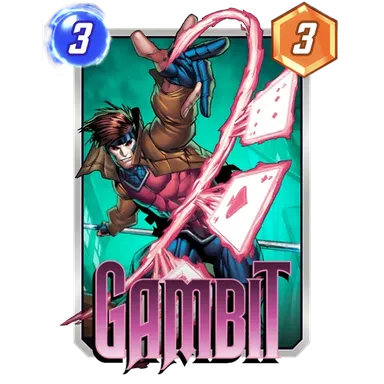
There are two different complaints hiding inside frustration with a quiet OTA. The weak complaint is that some currently frustrating cards should have been changed immediately. Gambit may create an unpleasant play pattern, and a future nerf could still be reasonable, yet a week in a new format is not enough time to prove that every strong-looking strategy has no answer. Waiting is not inaction when another balance window is close. It is how a game finds out whether players can adapt.
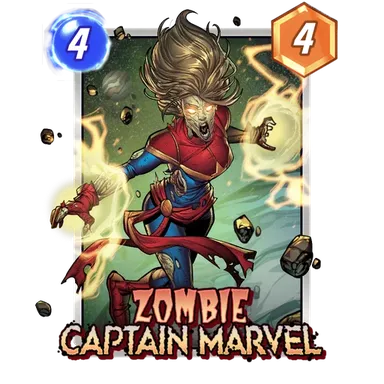
The stronger complaint is about what small buffs mean for cards people already care about. A Zombie Captain Marvel player who was already committed to the card does not suddenly have a new deck because of a minor increase. Someone who did not want to play it has no reason to start. The fear is that a card can become just good enough to miss another OTA without becoming good enough to alter anyone's choices.
Novelty also matters because players feel the metagame through repetition. When a small group of decks consumes a large share of opponents, content and netdecking feed the same experience: familiar matchups arriving again and again. A balanced field may be healthier than a reckless shakeup, but it can still feel stale. A quiet OTA can still be good management. Balance and freshness are separate needs, and the community is asking for both.
Victoria Hand is dependable, not inevitable
Victoria Hand's skill set is consistency. The Victoria Hand deck offers a solid mix of power and interaction. The discussion describes a Victoria Hand build with three paths: Victoria Hand, Gambit, or copying whatever goes tallest. This is a deck profile, and it is why she remains a sensible choice whenever the field changes.
The fraud-watch charge begins when consistency gets confused with destiny. The pattern is familiar: better decks are nerfed, Victoria Hand is near the top, and the prediction becomes that this must be her time. Then the field settles and she remains good rather than becoming dominant. Her chance to become the top deck after stronger decks get nerfed depends heavily on the supporting tech environment. When the cards that protect her are pushed hard enough, she benefits. Without that cover, she is still a strong, fair deck that can be outclassed.
The more useful comparison is Old Faithful. A metagame changes, you need a deck that can perform while matchups become clear, and Victoria Hand is there. That makes her a dependable sixth-player choice rather than an automatic championship favorite. Pick her because the current matchups support her. Do not pick her solely because another deck lost power.
Cosmic Ghost Rider keeps bad matchups playable
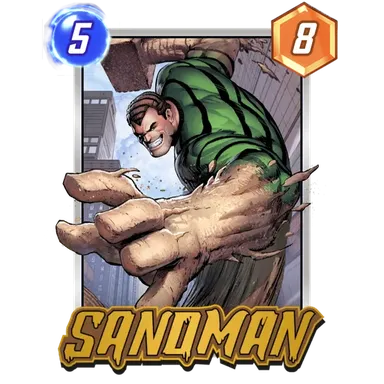
Sandman's role is contested: one case sees a declining, time-limited slot, while the other sees a card that is slightly less good in a metagame where it remains better than it has been for some time. For Doom 2099, the question is whether Sandman is a better five for that job than Cosmic Ghost Rider, Lady Death Strike, or Legion. Sandman can make an opposing final play less effective without making that play harmless. That may be enough in some shells, and insufficient in others.
Cosmic Ghost Rider earns a much stronger defense. Its value comes from moving a matchup from hopeless toward playable, allowing weaker curve-out strategies to reach turn six. It does not do this reliably enough to shut down the best decks. That role is healthier for a tech card than simply deleting a whole archetype from the game.
This is why Cosmic Ghost Rider is presented as unusually good design. Its interaction happens on the board, where opponents can choose how exposed they want to be. It can make room for decks that would otherwise have no realistic game against combo strategies, yet the decks it targets can still win. That pressure creates diversity without demanding a yes-or-no answer from every matchup.
A default tech slot should still be questioned. Sandman may be losing ground, and Cosmic Ghost Rider has to earn its place over other disruptive options. The case for keeping Ghost Rider is that cutting it makes a range of otherwise mediocre decks far less viable. More importantly, this is more than a favorable tech exchange. It is an argument about what kinds of Marvel Snap decks can exist at all.
Shadowlands Daredevil needs a shell that fights back
Shadowlands Daredevil passes the basic strength check. It is an efficient stat stick with a meaningful deckbuilding restriction, since shuffling Demons into the deck can dilute its ability to function as a tech deck. The current ramp shell looks promising because it does not ask Shadowlands Daredevil to solve every matchup through points alone.
Ramp can carry Cosmic Ghost Rider, Magneto, Lady Death Strike, and Legion alongside Shadowlands Daredevil. Those cards cover the problem a stat stick cannot solve: an opponent who is about to scale past it. The deck can win with its efficient early body, then use disruptive plays against Captain Carter and Maverick lines, or against opponents copying Victoria Hands.
The central build lesson is clear. Trying to make the Demons less awkward through draw or other narrow fixes is not enough by itself. A deck that simply adds points can still lose when the opponent combos off. There is a difference between efficiency and total output. Shadowlands Daredevil supplies efficiency. The surrounding shell must supply the interaction that turns efficiency into wins.
This also explains why the ramp version stands above the other experiments. It has the room to include several high-impact disruptive cards, while other Shadowlands Daredevil lists lean too far into their own points. Those lists risk becoming low-output combo decks that cannot answer a stronger combo deck across the table. The jury is still out on whether Shadowlands Daredevil has another lasting home, but ramp currently addresses the card's biggest limitation instead of pretending it does not exist.
More possibilities changed how cards are judged
Two explanations remain in tension. One wonders whether the Snap player has evolved from a card gamer toward a minmaxer over the last few years. The other says the game changed: as more finicky cards are added, they can cover each other's weaknesses. That creates more ways to build around multiplication, copying, and scaling than existed earlier.
The discussion also turns to Captain Carter and Maverick. The deck built around them can be played incorrectly when it is treated as a Surfer deck first. A Brood and Surfer line may look natural, yet when Maverick is behind Captain Carter, the example favors buffing both cards to produce more power on Brood. Prodigy and a second copy effect matter because they copy those central cards. The deck's identity is its Captain Carter and Maverick engine, not every familiar card beside it.
Wilson Fisk is boring but good
He is a bland but good card, especially in a Super Giant plan that wants early stats to help lock down a game. The design also lands thematically. One Kingpin taxes opponents for moving into his territory. Wilson Fisk acts like a bully. Boring does not mean weak, and a straightforward card can be exactly what a focused shell needs.
The unresolved question is whether Shadowlands Daredevil can adjust to context outside its current ramp home.
Watch the full discussion: the original episode.