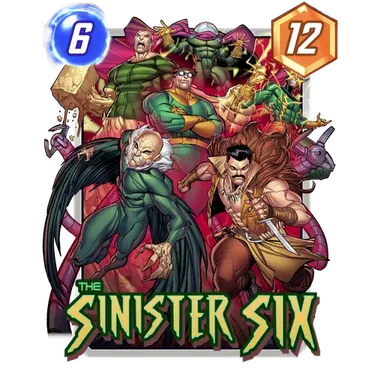
Sinister Six arrived looking like a meme and left testing with a real recommendation. The source began from the surprise: a six-cost card with a wild game-start instruction seemed destined to be a novelty. Instead, it had more homes than expected, a high ceiling, and enough competitive potential to justify serious work.
The key finding was not that every Sinister Six list succeeded. Several cute ideas did not. The value came from identifying which packages let the card use the evil characters it has drawn without making the rest of the deck wait around for a six-cost payoff.
Doom 2099 made the first case
Doom 2099 was one of the early shells that performed better than expected. Sinister Six does not look built for that deck at a glance, yet the fit held up in games. The source cited a strong record from the version tested and described it as one of the better decks of the day. That was important evidence that the card was more than a single gimmick or a Destroy-only curiosity.
The broader lesson was that Sinister Six can live in a list where its result is useful without being the sole plan. The rest of the deck needs to create pressure and give the player something to do while Sinister Six develops. That is a much healthier position than asking the whole deck to serve one late reveal.
The slow skill package did not get there
There were experiments with huge energy, Fastball Special, Galactus, Man-Spider, and multiple Skills. Those were fun to try, but the source found them too slow for Sinister Six. Drawing extra Skills delayed the evil characters, and the deck was paying too much time for a payoff that did not always arrive in the right state.
That failure is part of the useful answer. Sinister Six has a lot of room for creativity, but it still needs the deck to respect its timing. The card cannot carry every ambitious combination simply because the merged result can become large.
Destroy is the most natural home
The strongest structural discovery was that Sinister Six behaves like a Destroy card. When an evil card is destroyed and reaches the graveyard, Sinister Six can pull it into the merged result later. Venom can consume evil cards and still leave them available for that final absorption. That creates a double-value pattern that the other shells did not reproduce as cleanly.
The source did not say Destroy is the only future. It said this interaction changed the testing priority. The card's ability to reclaim cards from the graveyard gives Destroy a reason to explore it beyond the novelty factor, while other decks may still find their own better configurations.
Verdict
Sinister Six is good, and it is worth pursuing. The card landed in the useful middle ground of being competitive enough to matter and strange enough to keep games interesting. Start with Destroy or the successful Doom 2099 direction, then test from there rather than assuming the first flashy combo is the answer.
Watch the source video: the original episode.