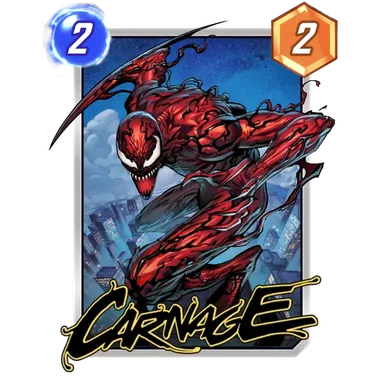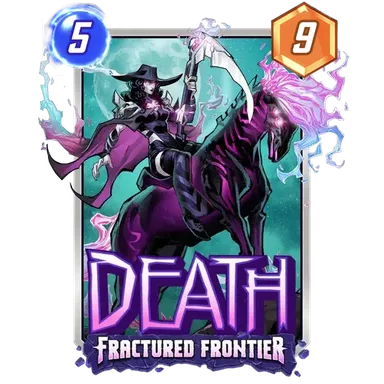
Before playing a card that brings back your destroyed characters, check what you're bringing back alongside the Power. A destroyed Carnage is still a Carnage. Returning it to a valuable lane can undo the board you spent the game building.
That was one of my problems with Death Fractured Frontier in our Episode 153 discussion. You use Venom to destroy Carnage, then the mass return sends Carnage into your big lane. The extra body sounds good until its effect starts eating the cards you wanted to keep.
The decision begins before the revival turn. Every card you destroy becomes something you may need to account for later.
Count effects as well as bodies
A destroyed pool can contain a mixture of useful Power, effects you want to repeat, and effects that become dangerous on a different board. Treating all of those cards as extra points hides the risk.
Carnage is a clear example because its On Reveal destroys your other cards at its location. Earlier in the game, that can be exactly what you wanted. Later, a lane full of cards you intend to keep presents a very different situation. The card has the same job; your board no longer wants that job done there.
Before a mass return, walk through the pool by function:
| In the destroyed pool | What to check before returning it |
|---|---|
| A body you mainly want for its Power | Whether a possible landing place actually helps you win a location. |
| An effect you want to use again | Whether the new board still gives that effect a useful target or result. |
| A card that destroys your own cards | What it could remove if it returns beside something valuable. |
These categories can overlap. A card can bring useful Power and still have an effect that puts the rest of its lane at risk. Count both parts before calling the return an upgrade.
The destroyer can become the problem
In my August 22 deck discussion, I specifically liked leaving Carnage out of one Death Fractured Frontier build. I was blunt about how badly it fit what that version wanted to do. The point was to bring useful effects back without making the revival itself the only way the deck could win.
That preference doesn't mean every destroyer belongs in the same category or that every return is unsafe. It means the actual contents of your destroyed pool matter more than the label on the deck. If your early sequence puts a harmful effect in the pool, the late sequence has to live with that choice.
Don't count a destroyer as harmless just because it already helped you once. Ask what its effect would do to the board you are about to have.
Compare control over the result
Death Fractured Frontier returns destroyed characters to random locations. That makes the destination part of the decision. A plan that needs a particular card in a particular lane has a different requirement from a plan that can use the returned Power in several places.
In the closing discussion from Episode 153, I preferred knowing where my combo piece would go. KM Best made the case for Death Fractured Frontier bringing several things back. Both points belong in the comparison: how much material returns, and how dependent your win is on its placement.
Read the return effect you're actually using. If it gives you more control over the destination, evaluate what that control preserves. If the destination is random, check the harmful placements as well as the exciting ones. The source discussion doesn't establish a universal spawn order or a reliable probability for the result you want.
Check the lane you cannot afford to lose
Imagine you have a valuable lane and a destroyer in the pool. The tempting calculation adds the returned cards to your existing points. A more useful check asks what happens if the destroyer reaches that lane while those valuable cards are present.
If that placement reverses your winning position, the risk belongs in the play decision now. A smaller return, a different sequence, or keeping your existing board may serve the match better. Which option works depends on the cards you actually have available. The guide to sequencing and holding cards develops that wider play-versus-hold decision.
The full Death Fractured Frontier discussion covers the broader disagreement about the card. For this turn, check one thing first: whether the pool contains an effect your best lane cannot afford to receive.