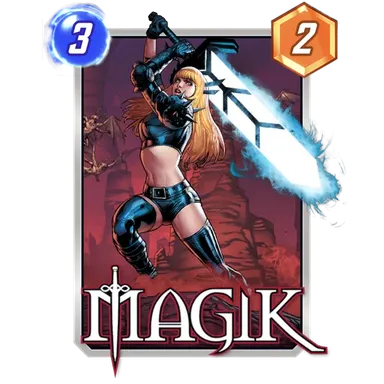
Before playing Magik, compare what turn seven gives both decks. Getting another turn to finish your plan can feel great. It can also give the opponent the exact amount of time they needed to go over the top of you.
I pushed back on adding Magik to double-Thanos lists during Marvel Snapcast Episode 153. KM Best made the wider point: if you choose to extend the game and you're bringing the second-biggest Magik deck, you're in trouble. That was an August metagame discussion, but the question applies whenever you decide whether the game should last another turn.
Your opponent gets to use that turn too. Count their gain before committing to yours.
What does the extra turn actually unlock?
Magik's On Reveal changes its location to Limbo, but it doesn't work after turn five. While Limbo is active, the game has a turn seven. That changes the schedule for both players, including when they can finish a setup and how much they can fit into the game.
Name your reason for extending it. Perhaps a sequence needs another turn after the cards you already intend to play. Perhaps you need a later opportunity to combine the pieces in your hand. Be specific about what becomes possible.
Then ask the same question about the opponent's visible plan. What have they already invested in? Does another turn let them finish an unfinished setup, add another large payoff, or use support that has barely contributed yet?
A plan getting larger is useful only in relation to what it has to beat. If your extra turn produces a little more Power while theirs enables the play you had no answer for, the extension hasn't helped your position.
Compare the gains, not just the final screenshot
You can't know every card in a closed-list opponent's hand. You can still compare plausible next steps using what they've shown. Keep the uncertain parts uncertain rather than assuming their hand contains every payoff or none of them.
Consider these hypothetical decisions:
| Situation | What the comparison suggests |
|---|---|
| Your visible sequence needs another turn to complete, and the opponent has shown a board that your completed line can realistically beat. | Extending the game has a clear purpose. Check whether the opponent has a plausible larger follow-up before committing. |
| Your plan already works by turn six, while the opponent has invested in a setup that needs more time. | Magik may solve the opponent's problem. Identify a specific gain for your own deck before handing over the extra turn. |
Neither example is a match result or a guarantee. The point is to compare what changes because of the extension. A deck with a spectacular turn-seven finish can still be the smaller deck in that particular game.
This was why the episode's Magik discussion allowed for a deck that had a good reason to extend the game while criticizing others that added her too casually. It wasn't a blanket instruction to stop playing the card.
Keep a turn-six fallback
Limbo can be removed. If your only winning sequence depends on it surviving, account for what happens when the game no longer gives you the extra turn.
Before deciding to defer your payoff, check whether your cards can produce a useful turn-six finish. The fallback may be smaller than the ideal version. It still needs to be a real sequence you can play, rather than a hope that the opponent leaves Limbo alone.
The discussion of deck plans and recovery develops that question. If the surviving line cannot compete, the guide to when to retreat covers the next decision.
Make Magik earn the extra turn
The useful comparison is specific to the cards and locations in front of you. A deck that benefits from Magik in one matchup may give away too much time in another.
Before playing her, be able to name what turn seven unlocks for you, what it plausibly unlocks for the opponent, and the finish you can still make if Limbo disappears. If the opponent gains the stronger line and you already had a workable turn six, keep that schedule in your decision.